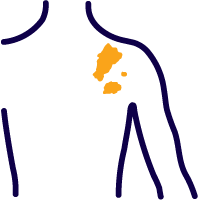
Flat, light brown spots on the skin
called ‘café au lait’ spots

Neurofibromatosis (NF) is a rare, progressive, genetic condition, with the most common type being neurofibromatosis type 1 (NF1). NF1 can impact every organ system and be involved in the development of non-malignant (non-cancerous) tumours that may affect the brain, spinal cord and nerves.1,2
NF1 is also one of the most common inherited disorders and is caused by a mutation or flaw in the NF1 gene. Half of all people with NF1 are estimated to inherit the mutation from a parent while the other half have no family history.1-3
Up to 50% of people with NF1 may develop non-malignant tumours on the nerve sheaths called plexiform neurofibromas (PN).4
PN can appear anywhere inside or outside of the body. While they are often identified in infancy or childhood, the impacts of PN can persist into adulthood. As a lifelong condition, PN may also appear later in a person's life. Some PN can grow fast and become large, which can progressively interfere with normal physical functions. 4,5,6
Although PN may start as non-malignant, PN will later become cancerous in a small proportion (~10%) of adults and can be associated with reduced lifespan.7,8
The severity of NF1 can vary significantly and people with the disease may not develop every symptom.4
called ‘café au lait’ spots
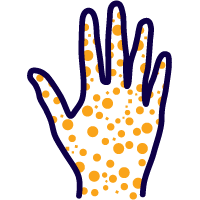
Neurofibromas
Reference.4
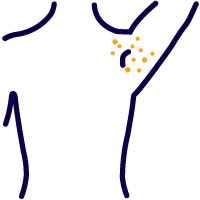
such as the armpits or groin area

tumours that develop in the cells surrounding the optic nerve
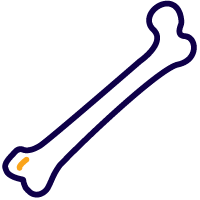


Back bone deformities
called 'lisch nodules'



High blood pressure
Veeva ID: GL/UNB-NF1/0097